Burnt Bread

burn the bread

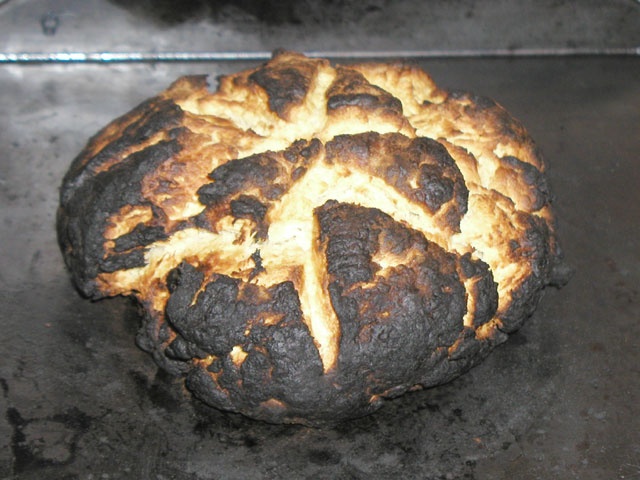
“Afterward take the various breads from their hands, and burn them on the altar along with the burnt offering. It is a pleasing aroma to the Lord, a special gift for Him.”

Exodus 29:25


I’m trying to look at this through the eyes of the Israelites who were hearing these instructions for the first time. They were wandering, fresh nomads who had not settled and did not grow crops. They walked out every morning hoping there would be food on the ground to gather so they could eat that day. They hadn’t been disappointed so far, but they couldn’t keep leftovers, so it would be easy to be a little on edge about the food issue.

And then they hear this:

Make bread, not from the manna you have plenty of, but from fine wheat flour and oil. Put the loaves in a basket at the tabernacle entrance before the Lord. Then put the basket in the priest’s hands to hold up toward the Lord. 

And then burn them.

Eventually this became normal as Israel grew accustomed to God’s law, but initially, I wonder if anyone reacted.

You mean make bread, loaves of good, hard-to-come-by bread, and then burn it on purpose?! What a waste! We could eat it and put it to good use after you’re finished holding it up in a basket! Why burn it?

But they were not to eat it, because it was holy.

It is hard, when God asks me to offer something I think could be used a better way, to remember that if it is offered to Him, it is not wasted.

My time, my training, my plans – even as I lay them before Him and follow, I am often upset when I don’t see what my sacrifice accomplished; when it seems like what I’ve given up was wasted.

It doesn’t seem like burning bread would accomplish all that much, but maybe burnt bread did a whole lot more for the Israelite people as an offering than it would have as food. Giving up perfectly good bread to be burned took trusting that there would be manna tomorrow; it meant deciding that it’s not as ridiculous as it seems to burn up food when you know the One you are offering it to can come up with plenty more.

Maybe sometimes, what God asks me to offer is not only about what He could accomplish with what I give, but about what He accomplishes in my heart by asking me to let go and give it to Him.

Let’s be honest, somebody put in the work to make those loaves by hand, and some of the loaves fed the priests, but some of them were tossed in the fire, and if it had been me, it would be easy to throw up my hands and say

“If you were going to burn three of them, why didn’t I just make three less?! That’s time and wheat flour I can never get back!”

But another way to react would be this:

“The loaves I crafted with these fallen hands were considered too holy for human lips. They were destroyed, yes, but that burning was a gift to the Lord, and He does not think it was for nothing.

Lord-

When I don’t see what we’re accomplishing here, help me to remember that it is a sweet and holy thing to give to you – that I can trust the hands in which I place the offerings I hold precious, and I can value the work you do in my heart even when it seems like what I’ve given is burnt or lost. Maybe sometimes, my soul needs to do something hard so I will remember that you are there in the hard things. And when I let something I think I need go, I see again that you are still taking care of me, and that nothing you ask me to give up will leave me at a deficit.

Thank you, Lord, for holding my small gifts as precious, my unseen sacrifices as special, and for never wasting what you call me to offer.


Grey Areas

grey area 2

“Suppose someone leaves money or goods with a neighbor for safe-keeping, and they are stolen from the neighbor’s house…if the thief is not caught, the neighbor must appear before God, who will determine if he stole the property.”

Exodus 22:7-8

Until this point, Moses and the men he had appointed had been handling every dispute the thousands of Israelites came up with and could not settle themselves. Here, God started laying some ground rules. Many situations were covered in detail so that no third party had to be brought in to decide the matter; they already had His decision on what should be done in writing.

But this verse caught my attention because, while He did significantly relieve the amount of involvement required of the human leaders, God did not just put in place a bunch of rules and then leave them to it. He wrote himself into them over and over.

If no one saw the thief, I saw, bring it to me. (v. 7-8)

If no one knows whose claim is true, I know, bring it to me. (v. 9)

When the complaint of the helpless falls on deaf ears, I hear. They can bring it to me and I will do something about it.  (v. 22-24)

The law was never entrusted to human hands with the intent that they would interpret or enforce it independent of their God. He did not designate a person who would be the go-to for difficult situations or grey areas. He designated himself.

It was not just a legendary document with mystical origins; it was communication from a God who continued to offer communication. A God who did not stand aloof, far-off, watching people struggle to discern what He really meant. A God who was heavily involved with his people, who did not ask them to stand and face the oncoming chariots without coming down himself to stand in the way.

Not too busy or too important to step into their individual situations.

He asked them to bring him into it; into disputes, into mysteries, into feasts. He intended for them to make Him an integral, familiar part of their daily lives. He was a God to be held holy and regarded with caution, but also a God that they recognized was for them; a God that was concerned with the smallest matters of the heart as much as He was with battles and territories and armies.

Lord-

Teach me this: you still offer to be heavily involved with my oh-so-daily problems and decisions. You want my heart to acknowledge you in all of it. There’s no category where your preference is that I not bother you with it. And you come yourself to stand guard, to hold me firm.

There are not enough black and white situations for me to just go off of rules and not ask for understanding. Life is full of grey areas. And so, from the beginning, you have said to come to you when I don’t know what to do. Mold my view of you so that I expect your invested interest and help, and learn to come to you eagerly, with all of it.

“Trust in the Lord with all your heart and lean not on your own understanding; in all of your ways acknowledge him and he shall direct your paths.”

Proverbs 3:5-6

Rivals

rivals

“And the Lord said to Moses, “Say this to the people of Israel: ‘You saw for yourselves that I spoke to you from heaven. Remember you must not make any idols of silver or gold to rival me.”

Exodus 20:22-23


He had just explained this in the 10 commandments: No other gods. No images.

And then, His presence fills the mountain with smoke and thunder and the people draw back and ask for an intercessor, and the first thing He brings up to Moses is this:

NO OTHER GODS. NO IMAGES.

You have just seen it, I have no rival. Don’t invent one.

The Lord went on to tell them that when they were building altars they weren’t even allowed to shape the stones. Why? Because what we design, we tend to worship. Anything we craft becomes a rival. And the God of lightning and billowing smoke should not have to compete with a pile of rocks.

How little it takes for my attention to drift. How low my view of Him has become when I allow anything to rival Him in my heart. How quickly I forget, even when He’s just reminded me. And so, just as He did with the Israelites, my patient God reminds and reminds and reminds:

Let your heart belong only to me. NO OTHER GODS.

“Dear children, keep away from anything that might take God’s place in your hearts.”

-1 John 5:21

“Keep your heart with all diligence, for out of it spring the issues of life.”

-Proverbs 4:23

I read today that “love vigilantly guards [marriage’s] purity.” (Ryan + Selena Frederick in Two as One)

I think the same concept applies to my relationship with the Lord. His love has made me secure. But I must not relax when it comes to the leanings of my heart. They require guarding. Love vigilantly guards.

So Lord-

Help me. Help me to diligently keep my heart. Teach me to immediately respond when it begins to construct rivals. Make me sharply aware when my worship drifts. Build our relationship and teach me to fiercely protect it. Let the echo of your words from so many years ago resonate through my heart still, reminding, always reminding:

No other gods. I have no rival.

No Water

no water“At the Lord’s command, the whole community of Israel left the wilderness of Zin and moved from place to place. Eventually, they camped at Rephidim, but there was no water there for the people to drink.”

-Exodus 17:1


At your command, they ended up camping where there was no water.

In hindsight, you made water come gushing out of a rock, so it was no big deal. But at the time, thousands of people were losing daylight and there was NO WATER. No time to move somewhere else, tormented by thirst from a long day’s journey, not knowing how far they’d have to travel tomorrow, or the next day, or the next, and still find no water, and prod their livestock on with no water, and watch their kids with no water.

Anyone who doesn’t know You starts to ask: “Who exactly is running this operation?! How can He be this All-Knowing God if He led us here?!”

And even those who do know You fight back those questions.

But if I know You well, and I’m here by your command, and there’s no water, I start watching closely to see what You will do.

Because I know that You don’t lead those who follow You into traps. You don’t bring them into something that wasn’t planned out all that well. You don’t drop them into a helpless situation and leave them to fend for themselves.

That’s not who You are. That’s not how a good shepherd acts, and You call yourself the Good Shepherd.

You are a God of details, of  “do not be afraid,” of  “stand still and see what I will do.”

And when You direct my steps into dry places, I must learn to expect that You will bring the water. When you direct my steps into danger, I must learn to remember that You stay and stand guard. When I don’t understand why You led me here, I must hold on all the tighter to who I know You are.

Because if I discard what I know of You when I interpret what’s going on, I come away with wrong assumptions that damage my heart. I turn on You and complain, instead of just asking for help from a God I know is ready and willing to help me.

To emotionally survive what we will walk through, I must learn how to keep my heart from going there.  I must look around, see that there’s no water, take a deep breath and say,

“Okay, I don’t understand this, but I still trust You; so I will watch closely to see what You will do.”


The Roundabout Way

walking in circles


“When Pharaoh finally let the people go, God did not lead them along the main road that runs through Philistine territory, even though that was the shortest route to the Promised Land. God said, “If the people are faced with battle, they might change their minds and return to Egypt.” So God led them in a roundabout way through the wilderness…

-Exodus 13:17-18

It was wilderness that had them questioning Your goodness, wondering if they would die, and pining for slavery. But they did not turn back. Battle might have turned them back.

It was not even a battle they were entirely avoiding. Israel would battle Philistia for years to come. But they weren’t ready now, and so You took them through the wilderness to give them time. 

How many times have I banged my fists against the wall in frustration over how much time we could have saved if You had just led me directly? I have sobbed in agony over lost time, lost plans, roundabout routes. I have glared as I’ve questioned You bitterly: why the detour? Why the mystery? Why not just show me where we’re headed and then take me straight there?!

Maybe it’s because I wasn’t ready for the battle.

Maybe if I’d gotten there earlier, I would  have turned back. Maybe the roundabout way was not to steal away my precious time, but to give me precious time before I faced what would come. You give treasured lessons in the wilderness and essential preparation en route. And You know human hearts.

You know when they’re ready and when they’re not. You patiently endure our complaints and accusations all along the way as You gently steer us around the battle that would have destroyed our young courage before it had time to find its footing.

Lord-

Thank you for giving me time. Thank you for not rushing my unsure soul into the fray. Thank you even for the wilderness, for the roundabout way, because they show that You were taking your time with me – even when I did not realize I needed it.


Slaves. Warriors.

handcuffs

“On that very day the Lord brought the people of Israel out of the land of Egypt like an army.”

-Exodus 12:51


They had no military training. Until this day, they had been slaves. They did not know how to wage war; they knew how to make bricks. They had been oppressed, broken, despairing. Their infants were murdered, their slave-drivers were harsh, their leader disappeared to Midian for 40 years.

But this day, they swept out of Egypt like a force and left the most powerful nation in the world  plundered, trembling, and begging for their blessing. This day, they were warriors, and not a one of them had lifted a sword.

The world feared them.

Because to take on Israel was not a matter of overcoming 60,000 fighting men – it was to take on the living God who had devastated Egypt and crushed its deities.

This God who does not choose the strong, the bold, the best. This God who takes the weak and does mighty deeds; who takes the coward and brings down the fearsome; who lifts up the least and makes him ruler. This God took slaves and made an army that the world watched in terror.

This God calls me.

So I do not have to be the best, the bravest, the strongest. I can just be me and He will still work wonders.


photo credit: Marc Czerniec

Post-Rescue

life preserver on land

“…the thunder and hail will stop, and you will know that the earth belongs to the Lord. But I know that you and your officials still do not fear the Lord…”

…So Moses left Pharaoh’s court and went out of the city. When he lifted his hands to the Lord, the thunder and hail stopped, and the downpour ceased. But when Pharaoh saw that the rain, hail, and thunder had stopped, he and his officials sinned again, and Pharaoh again became stubborn.”

-Exodus 9:20-30, 33-34


I tend to think it’s an Israelite trait to be stubborn and rebellious the moment I’m out of trouble; to require bailing out again and again. I tend to bemoan that I, too, am Israel: aware of You in my need, forgetful post-rescue.

But here I see that pattern in Pharaoh and his officials, and I see Moses calling them out on it before they even turned. This is what he noticed, even in the shining moment where they appealed to You for help:

their hearts did not fear You.

A heart that only sees You when it needs help but ignores You in the quiet and turns from You as soon as You answer, does not fear You. And it is not just an Israelite trait – it is a human trait. We’re willing to call on You when we’re in over our heads, but we don’t want to need You. We want to be able to handle it on our own. So as soon as we’re back on dry land, we turn. We humans are tragically alike in this: we do not fear You.

The other thing I noticed is that it is not only Pharaoh that Moses accuses. The officials also sinned. Pharaoh called the shots, but they were still responsible for their own hearts. While it was Pharaoh’s call, his officials did not get to hide blameless in his shadow. They, too, chose not to fear You. They, too, disregarded your words.

They, too, chose to turn as soon as the thunder stopped.

Lord-

Soften my heart toward You. Build in me a fear of You that outlasts the storm, that lives in the quiet, and that remembers how I need You even when things seem under control.

A Side of You I Didn’t Know

iceberg

“Now you will see what I will do to Pharaoh. When he feels the force of my strong hand, he will let me people go…I am YAHWEH-the Lord. I appeared to Abraham, Isaac, and Jacob as El Shaddai – God Almighty – but I did not reveal my name YAHWEH to them.”

-Exodus 6:1-3

YAHWEH (יְהֹוָה)

“The divine name was increasingly regarded as too sacred to be uttered, it was replaced vocally in synagogue by Adonai (Lord)…Many scholars believe that the most proper meaning may be “He Brings into Existence Whatever Exists” (Yahweh-Asher-Yahweh)” 

-Encyclopedia Britannica

I guess there’s a lot about this name that remains a mystery. But what caught my attention in Your answer to Moses’ cry was this: You had more to reveal about yourself than he had seen so far.

His ancestors called You ‘God Almighty,’ but Moses was about to see how strong your hand was. His ancestors had known You as ‘El Shaddai.’ Moses was only now introduced to YAHWEH.

I’m not sure what all is lost in translation across the years, cultures, languages. It’s 2017, I am snuggled up in my recliner in front of an electric fireplace with a fake flame, journaling as I prepare to travel a hundred miles to go to work flying in a helicopter.

I am worlds apart. But reading this, this morning, the name struck me.

Moses came to You, upset at the worsening situation, wondering why You didn’t act, and You answered with:

Your fathers knew me as Lord Almighty, but I am about to show Pharaoh who I am with force. And you shall call me

YAHWEH.

Silence. Holy. That’s what the statement left resounding through my morning. You were about to unleash upon Egypt a display the whole world would recognize. You were about to reveal a side of you Moses didn’t know yet.

And then, thousands of years later, You did it again. You still had more to reveal about Yourself than Israel had seen so far.

“…and you shall call his name Jesus…”

Matthew 1:21

Savior. Rescuer. King.

Gentle. Feisty. Healer.

Man of puzzles. Friend of scum. Opposer of the Pharisees.

The One who forgives sinners.

So here I am, recognizing that in all of my situations, I must come to You, not only hoping to remember all I have learned of You before, but expecting to be surprised by a side of You I didn’t know yet. Always expecting that You still have more to reveal about Yourself than what I’ve seen so far. 

So keep my heart intrigued with You, Lord. Leaning forward, not knowing what to expect, not sure what side of You I will see, but settled in this:

You are so, so good, and the deeper I go with You, the more I want to truly know You.


The Middle

middle

“Then Moses went back to the Lord and protested, “Why have you brought all this trouble on your own people, Lord? Why did you send me? Ever since I came to Pharaoh as your spokesman, he has been even  more brutal to your people. And you have done nothing to rescue them!”

Exodus 5:22-23

On the other side of that statement lay plagues, sea crossings, and freedom. But at the time, Moses couldn’t see that. At the time, he wondered, Why did I even try? Why send me if I only make things worse!?

It’s the middle of the story. That frustrating place where all we can see is the destruction caused by things shifting without the reassurance of what they’re shifting toward. How easy, in the middle of the story, to get discouraged and assume You are not going to help us.

May I, like Moses, come to You to voice that frustration. May I be honest about what I’m feeling, but still direct my cry to You. And even better, may I learn to assume that it’s okay when things look like this. It is part of shifting, of growth, of change. Things gets ugly before what will be starts to take shape.

Transform my heart’s cry from, “You have done nothing! You’re not helping!” into  this:

“I don’t see it, but I know You’re working in this, I know You’re helping. It looks ugly and ruined right now, but I trust You to take this somewhere good.”

Help me to endure, hold on, and refuse to slam the book shut in the middle of the story.

Nearsighted

beka's eye

The eye is the lamp of the body; so then if your eye is clear, your whole body will be full of light. But if your eye is bad, your whole body will be full of darkness. 

And if the light you think you have is actually darkness, how deep that darkness is!

-Matthew 6:22-23


I don’t remember when I started to lose my vision.

Little by little, my eyes stretched. They grew long instead of round. The curvature became more and more irregular, and more of the details I used to be able to see became blurry.

At ten years old, I started getting headaches in school. When my dad realized I couldn’t read the titles on the bookshelf across his office, he knew it was time to get me glasses.

At thirteen, we switched to contacts, hoping that placing correction directly on my eyes would slow the progression of my vision loss.

At fourteen, the eye doctors started recommending surgery.

At twenty, they stopped using the vision chart during exams of the naked eye. I couldn’t tell where it was.

Last month, a dilation test confirmed that my eyes have stopped changing and my prescription has stabilized.

I am left with three inches.

Three inches away, details are clear. It’s a small world without my glasses. Past three inches, there is a collage of colored shapes with smeared edges and poor definition. I lose facial features and can’t reliably tell who someone is unless they’re talking, and then I can’t always tell what they mean because I can’t read their body language. In a familiar setting, I do a pretty reliable job guessing at what things are, but then again, I did grab a set of earbuds from the nightstand this morning because they looked like glasses to me.

When I could wear my contacts I didn’t notice it that much. Now that I can only wear glasses, it’s more obvious. That square of clarity makes a big difference, but above, below or to the sides, I’m back to three inches. I can’t see down and ahead at the same time, and I have the bruises to prove it!

I lost my glasses in a lake a few weeks ago and spent three hours with my three inches while I waited for Cody to bring me a back-up pair of glasses. It gave me some perspective.

I am not blind. But I rely heavily on being able to either put on a lens or bring something closer to my face. If I can’t do either, I don’t rely on what I see. I know I’ve lost my bearings and, especially outside of familiar surroundings, I feel helpless.

It’s a silly illustration, but what if one day I woke up and decided to live like that? What if decided that what I was seeing was normal and didn’t adjust for it? What if I forgot my glasses on the nightstand and just went about my day guessing about what wasn’t clear?

What surprises would I bring home from the grocery store? What social cues would I misread? What if I decided to drive? Who knows where I’d end up and what damage I’d do on my way there?

I wonder if this is the concept Jesus was getting at when He described the deep darkness of someone who thinks they’re seeing light when they’re not. When you only have three inches, but you act like you can see miles ahead, you don’t recognize when you’re in deep trouble, much less see it coming in time to avoid it.

I would be in bad shape if I decided to ignore the fact that I have an eye condition that requires correction, so I don’t try to live without my lenses.

There is a Psalm that speaks of relying on God’s counsel that way:

“I have set the Lord always before me, because He is at my right hand, I will not be moved.”

Psalm 16:8

Always before me. Like a pair of glasses through which I see life clearly.

Always before me. Because I am near-sighted in more than one way.

Always before me. Because it’s not enough to have eyes that work; they must focus on the right thing.

“Trust in the Lord with all your heart and lean not on your own understanding.”

Proverbs 3:5

I don’t do anything I consider important without my glasses on. Why don’t I carry the same assumption toward my need for Him?

What if I didn’t start a single day without stopping to regard Him; to linger, to pause, to reflect, to remember that He is my confidence, that He is what I need for this day? How different would I be if I kept in mind that it is not something out there I must go after, that there is no higher pursuit than the God I kneel before in this moment? 

If I have not set my eyes on Him, I am walking out into the day without corrected vision, and my soul has an even higher prescription than my eyes.


Lord-

I don’t trust my eyes past three inches; teach me to regard my heart with the same suspicion. Unaided, it is an unreliable judge of what’s truly important. It is near-sighted, and the way it sees the world is as small and suffocating as those three inches I lived in when I lost my glasses.

Me, my wants, my worries, my ambitions, that is all I see until I stop to gaze on You.

I don’t see the big picture without the adjustment of worship and the lens of Your words. They are as necessary to my day as any pair of glasses, and more so. In the midst of all the things that call for my attention with the first tone of my alarm clock, that urge me to rush out and meet them without pause, I must remember this:

I need to wait until I can see what I’m doing.

Lord help me to remember.

As I look to tomorrow, the day I hope will bring me to where I open my eyes in the morning and I’m not guessing anymore; where I see clearly, without the smudges and scratches and borders of glasses; I also look to the day where it takes no extra steps to see and recognize how central You are. The day when my heart’s vision is permanently corrected.

When You are revealed,

and I shall be like You,

for I shall see You as You are.

(1 John 3:2)

What a difference good vision makes! Help me to remember, Lord, that LASIK does not solve my daily need to correct my view of You.


*Photo Credit: David Heckman