I’ve got you covered: on bringing nothing & being cared for

relaxed

“Don’t worry about anything; instead, pray about everything. Tell God what you need, and thank him for all he has done. Then you will experience God’s peace, which exceeds anything we can understand. His peace will guard your hearts and minds as you live in Christ Jesus.”

Philippians 4:6-7

Don’t worry about anything.

That’s the phrase I sometimes text to friends when they’re coming to my house and ask what they can bring.

It’s the phrase I use when I want them to relax without feeling that they need to prepare anything. Food? Bed? Towels? Coffee? Soft blankets? Phone chargers? I’ve got you covered. This is an evening for you to rest and just be.

I’ve always known this verse in the version that says “be anxious for nothing.” It was interesting to consider a different angle on the phrase.

How sweet it is that our God’s instructions are designed to give to us, not to take from us. That He himself reassures us with: “Don’t worry about anything.”

AKA: You don’t have prepare or bring anything. Just come, relax, rest, I’ve got you covered.

Perhaps that’s the type of ease and peace and “don’t worry” that he’s describing. The kind where you show up hungry after a long day, with messy hair and nothing to offer and you can just plop on the couch, be wiped out, and be cared for because you are in the home of someone who’s got you covered.

I will be your God throughout your lifetime—
until your hair is white with age.
I made you, and I will care for you.
I will carry you along and save you.

Isaiah 46:4

Hold Me Steady: on small needs and saplings

Support-Rope-Around-Young-Tree-Trunk

“Now may our Lord Jesus Christ himself, who loved us and by his grace gave us eternal comfort and a wonderful hope, comfort you and strengthen you in every good thing you do and say.”

2 Thessalonians 2:16-17


Early motherhood has been challenging from the get-go for me. More often than not, I feel empty and in over my head; like I’m sweeping together the very last bits of what I have in order to keep caring for this baby’s round-the-clock needs, to keep giving to my marriage, to keep putting time into my work.

I berate myself for not knowing how to walk through this, how to balance it all, for struggling with what is painful, for needing help.  It is a fleeting season, sprinkled with such sweet moments. There is progress and relief and growth. But the build-up leaves me spent. It’s rough to feel that you’ve run out of steam for the day and it’s only breakfast time.

Especially because I am in this stage, this verse hit me.

I needed the phrase, “every good thing.”

Caring for a new baby, my days are filled with small tasks, and though they are small, they are taking everything I have.  I need the reassurance that they count, that in tending to these small needs, I am doing good things, and that I will be given the comfort and strength I need for each and every one of them.

“Strengthen” in this verse comes from the Greek word sterixai, which means “to make fast, to plant down solidly, or to render constant.”

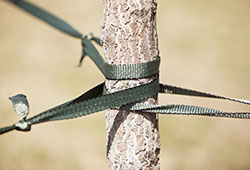
I love the image of planting. I am not that great of a gardener and I have been the person who excitedly dug a hole, plopped a young tree down inside it, shoveled in some dirt, and then watched in dismay as the soil gave way and the tree went sideways.

It is not enough to hastily drop saplings into post-holes and call it good. They need the right depth, firmly packed soil, sometimes even stakes and ties to help them remain upright.  Good planting is more than picking the right spot and dropping off a plant. Good planting provides the firm support a young tree needs to thrive.

And when it comes to my heart, God is a good gardener. He settles me firmly, he ensures that I have all the bracing I needs to stand upright. He plants me deep and firm when I feel like I am crumpling, tipping, and falling to pieces. He offers the fresh hope I need to rally for the next day, the next task, the next word. He calms me and makes me steady for the work ahead.

Lord,

I feel worn through. I am only a human person who gets tired and frustrated, who doesn’t always know what to do, who has real limits when it comes to energy and pain tolerance, who is adjusting to a lot of changes. But for every good thing that is mine to do and every kind word I am called upon to offer, you yourself will bolster my heart with your unfailing strength and endless grace.

I am not the sturdy, unwavering oak tree that I want to be. I am only a sapling. It is easy for me to get bent and broken and off-balance. But you are a good gardener. So plant me firm and remind me that I can rest and let you hold me steady.

Pervasive Holiness: be a sponge, not a mannequin

sponge water

“Now may the God of peace make you holy in every way, and may your whole spirit and soul and body be kept blameless until our Lord Jesus Christ comes again. God will make this happen, for He who calls you is faithful.”

1 Thessalonians 5:23-24

The first thing that caught my attention about this verse was the pervasive nature of holiness. It is not merely a characteristic of outward behavior, but a quality that courses through and defines one’s entire being. I am called to holiness through and through.

Holiness is not an act. Holiness is not a rule to follow. Holiness is not an outer layer. It is not something I display like a lifeless mannequin that models good clothing.

Holiness is a sense of belonging to that transforms every detail of who I am. It acknowledges that every single piece of me is rightfully His, and so imbued with purpose. It sees all of myself, every hidden corner, every silent thought, as sacred, for it is His territory.

Holiness defines the children of God, inside and out.

I also thought it was significant that this is not something accomplished by me. Every verb in the verse indicates that this is something produced in my life by the actions of another. My holiness is a result of His faithful work. He makes me holy.

I cannot bring about holiness. But as I yield to Him, every fiber of my being is swallowed up in and soaked through with it, like a sponge immersed in water. I am made holy as He is holy, and when you squeeze me, holiness spills out.

And so I will echo Paul’s prayer for the Thessalonians as I look on my own life, on the lives of those walking this walk alongside me.

Holy in every way.
My whole body and spirit and soul kept blameless
God will make this happen.

Lord, may you make this true of my life. May I be defined – my body, my spirit, my whole soul – by holiness. Be faithful to do this work in me. Make me blameless, just as you see me. And help me rest confident in your faithfulness to produce what is pleasing to you, right here in the deepest parts of me.

“May He equip you with all you need for doing His will. May He produce in you, through the power of Jesus Christ, every good thing that is pleasing to Him…”

Hebrews 13:21

The Wrong Question: on feeling qualified, broken plans, and how to walk forward

Moses gazed out across the sand.

It had been a good feeling to know his calling; to be so certain of his purpose. He had studied, he had prepared. He was a leader and he was well-equipped to lead. The timing was perfect, the path was clear-cut, he was not afraid to act. And then this.

Cruelty. Injustice. Tormenting of the helpless. This was his moment and he had seized it. He had stepped into his role as protector. He, Egyptian royalty, had swept in to defend a Hebrew slave. He was finally a part of his own people, he had taken up their cause and he could sense a grand story unfolding…

…except they did not follow him. “Who appointed YOU to be our prince and judge?” they had demanded, and his daring had slipped away as suddenly as the life in the slave-driver’s eyes.

And Moses ran.

He ran as far and as fast as he could. He ran until he could not see. He ran until he could not breathe. What had he been thinking? He had been bold and risky and then his whole world had given way with a single question and now he was here.

A prince without a people; an outcast, adrift in the desert sun. He had known his place. Now he had no place. He had been sure of what path to take. Now he wandered in a wilderness with no paths at all. Tears and sweat stung his eyes. He wiped at them furiously and let out an exasperated grunt. How could this have happened? How could such a noble ambition amount to nothing at all?

Moses shook his head and resolved to bury the question. He cast one long look back toward home and then turned his back on Egypt, on Israel, and on any aspiration of becoming someone significant. Moses walked away and tried to forget.

Forty years later, he had almost succeeded. And then one day, a flicker of hot white light caught his eye as he was picking his way through the wilderness scrub.

After taking quick stock of the sun’s position in the sky and the small flock of animals grazing behind him, Moses unknowingly took his first step toward a path he had abandoned a long time ago.

“You must lead my people out of Egypt, “ the God who spoke from fire told him.

Moses thought he might throw up. All the disillusionment and fear and frustration came hurdling back in a wave that overpowered and surprised him. NOW you want me to lead your people?? No thank you, I already tried that and it cost me everything! It’s clearly NOT my place.

“Who am I to appear before Pharaoh? Who am I to lead the people of Israel out of Egypt?” Moses argued, squinting at the flame.

“I will be with you…” God answered, “Say this to the people of Israel: I AM has sent me to you.”


From Beka’s Journal:

Gazing Uphill: two ways to react to things that are too hard

uphill

“…Saul realized that his troops were rapidly slipping away. So…Saul sacrificed the burnt offering himself.”

1 Samuel 13:8-9

“…Jonathan said to his armor-bearer, ‘Perhaps the Lord will help us, for nothing can hinder the Lord. He can win the battle whether He has many warriors or only a few.'”

1 Samuel 14:6


These two chapters of 1 Samuel tell two very different stories that paint an important contrast. The first is of Saul, king of Israel, who sees the battle before him, watches his resources dwindle, and panics. The second is of Jonathan, who sees the same enemy and charges ahead with only his armor-bearer.

Two men, clambering uphill and fighting as they went, took down every soldier in their path. God sent an earthquake for good measure and the entire Philistine army retreated before them. Jonathan did not have the resources for the battle any more than Saul did, but he had in view a God who does not depend on numbers.

Saul’s actions were based on fear over how few men he’d have to fight with. Jonathan’s were based on the confidence that if the Lord fought the battle, he had all he needed with just his armor-bearer.

Daily I’m faced with the same choice: what will I weigh as the bigger factor? God or something else? Will I see all the worries of my situation or all the possibilities of a limitless God? There are two ways to react to things that are too hard: I can do the math and panic and try to handle it myself, or I can remember that I don’t have to handle it myself, because whatever it is, it is not too hard for Him.

May I learn to make decisions like Jonathan, where I cast my life upon God’s power and goodness rather than dishonor Him because the situation didn’t look perfect. May I see my advantages melting away and refuse to fear because He does not need those advantages to care for me.

May I, like Jonathan, be willing to fight an outnumbered, uphill, impossible battle because I have a clear view of my God and I know He is looking for someone who’s willing to trust Him and He does not need perfect situations or even playing fields.


Lord-

Mold me to be a servant after your own heart: to love you more than certainty, to follow you rather than perfect circumstances.

It’s crazy to leave solid jobs and go romp overseas hoping to make a difference, especially with an unsure income and a baby in tow. But I believe you will use our lives to show people how worthy and powerful you are – that it’s worth casting away fear and following you, outnumbered, uphill, into the unknown, wherever you may lead, because you are so much more than anything else the world has to offer.

You are enough for our souls, and nothing else – no security or perfect situation or realization of our highest goals – ever can be.

Our hearts will regret where we let fear hinder us from following your lead, from waiting on your timing. 

So make me good at following at you and consistent at listening to your voice. That is the best set of qualities I can ask for. I do not want a predictable, low-risk, strategic life, but a life that dives into knowing you and jumps at the chance to see you work; a life that cares little for other ambitions, but cares fiercely about trusting you, about being loyal to you, about honoring your name; a life that made its decisions saying, “perhaps the Lord will help us, for nothing can hinder Him.”

Remind my heart this day, as I gaze uphill, that what is too hard for me is not too hard for you. 


 “I am the Lord, the God of all the peoples of the world. Is anything too hard for me?”

Jeremiah 32:27

But Make Sure Now: on failure and a clear path forward

Idyllic rural landscape in golden light

“Don’t be afraid,” Samuel reassured them, “You have certainly done wrong, but make sure now that you worship the Lord with all your heart and don’t turn your back on Him.”

1 Samuel 12:20


Life is full of bad calls. There are plenty of moments where I demand the wrong thing, when I put my trust in something unsure, when my heart chooses to worship someone or something less worthy, where I take a step or make a choice I can’t take back.

Here in this passage, Israel finally acknowledged their sin in rejecting God and demanding a human king, and I thought it was worth considering Samuel’s response:

Yes, you were wrong, but now do this.

“…but make sure now…”

Words that breathe the life of moving forward into the hollow emotion of regret.

When I acknowledge that I’ve been off, the very next right step is just what Samuel describes: worship the Lord with all your heart and do not turn your back on Him.

The natural response to failure is to pull away from the light that exposes it, but God asks us to do the opposite and lean in.

But if we are living in the light, as God is in the light, then we have fellowship with each other, and the blood of Jesus, his Son, cleanses us from all sin. If we claim we have no sin, we are only fooling ourselves and not living in the truth. But if we confess our sins to him, he is faithful and just to forgive us our sins and to cleanse us from all wickedness.

1 John 1:7-9

His answer is not to withdraw, to pull back, or to turn away. His directions to Israel were this:

Give yourself wholly to me again. Don’t turn away. Don’t turn back. Remember who I am and all I have done for you. You have certainly done wrong. BUT NOW DO THIS. Because we are not finished.

Step one to moving forward from failure is always this: Take your eyes off of the regret and put them on the One who moves you past it and into new chances and clean slates. Because He is not finished with you.

…I focus on this one thing: Forgetting the past and looking forward to what lies ahead,  I press on to reach the end of the race and receive the heavenly prize for which God, through Christ Jesus, is calling us.

Philippians 3:13-14


Lord,

Help me this day, as I acknowledge my own stumbling, to lay down  my obsession with getting it perfect and take up an excitement toward a God who is not limited by my failures and always offers me a way forward from my heaviest moments.

Donkey-Hunting Days: on small tasks and grand purpose

lost donkeys

“My thoughts are nothing like your thoughts,” says the Lord, “And my ways are far beyond anything you can imagine.”

Isaiah 55:8


I was reading 1 Samuel 9 this week, a story that starts out with a young Saul looking for his father’s donkeys and ends with an unexpected twist. After searching everywhere for the lost donkeys, Saul and his servant seek out the man of God, hoping, as a last resort, that he might be able to tell them where else to look. The seer does eventually answer their question about the donkeys, but not before announcing that Saul was the one God had just chosen to be Israel’s first king.

How bizarre that must have sounded to Saul, who started his day with one goal: find the donkeys.

He was not expecting meals of honor and anointing oil and prophecies about ruling the country or being the chosen one. He was barely expecting to be successful at donkey-hunting.

And yet, God had a different purpose for this day than Saul did.

I think, especially on the day I read this: sick-in-bed day #3, at the end of 9 months of nausea, in the midst of 10 months of transition, the story of Saul’s day was reassuring. Sometimes I look at all I’m working toward and it’s moving so slowly that I wonder if it will add up to anything at all. I feel like I have a lot of donkey-hunting days.

But the way Saul’s day turned out is a reminder to me that all I need to do is be faithful with the task before me and open to the possibility that God might have something entirely different in mind.

We never know for sure what our many, simple donkey-hunting days are building toward.

And He can build grand, sweeping moments into any one of them. 

It is His to infuse my moments with calling and purpose. It is mine simply to listen and look for His direction – even in small things like “where should I look next for the donkeys?”

So may I lean forward, content to do my best with what’s in front of me and, at the same time, expecting Him to use a life that seeks Him out in ways I could never imagine.


Lord-

Help me to trust you even with days that feel monotonous and unimportant: with transition days and sick days, with moving days and just meet-basic-needs days. You have made each of them and I can treat them as sacred unto you.

If I use them, even the simplest of them, just to be faithful to set my heart on you, you will be faithful not to waste it.


“…He is a rewarder of those who diligently seek Him.”

Hebrews 11:6

Fatal Observation: on noticing differences without growing discouraged

jealous

“Give us a king to judge us like all the other nations have…”

“Do everything they say to you,” The Lord replied, “for they are rejecting me, not you. they don’t want me to be their king any longer.”

…”When that day comes, you will beg for relief from this king you are demanding…”

But the people refused to listen to Samuel’s warning, “Even so, we still want a king,” they said, “we want to be like the nations around us.

1 Samuel 8, excerpts


Israel had just WON against the nations they were comparing themselves to, but one reigning desire was enough that they didn’t care what they were committing themselves to or who they were rejecting to have it.

They longed to be like other people. And it blinded them.

It’s a desire worth confronting in my own heart. For my life knows this bold and senseless craving that insists if only my life looked like that, everything would be okay.

I’ve experienced it in a hundred different ways. Right now this trap-like thinking has sunk its hook into the issue of pregnancy weight gain. What a small thing to cause such persistent unhappiness, but so it is. It’s even normal to put on weight when you’re pregnant, but, man, have I struggled with condemnation, shame, and a painful, repetitive self-assessment over it. Cameras make me want to hide and finding clothes that fit is a whole new challenge, but nothing gets those emotions going like the fatal observation of a beautiful pregnant person who stayed petite.

How readily I notice anyone and everyone who didn’t pack on the pounds in their pregnancy. What power a “belly-only pregnancy” has to dominate my attention and how often I find myself drowning again in thoughts of “why couldn’t I be more like them?”

And so I must pause at this chapter of 1 Samuel and consider the similar thought process it describes in the Israelites. I am not its only victim. Whether it’s a new king or a different pregnancy weight; a new relationship or a different set of talents; attention, approval, or success; that hair, that house, that car; we people are suckers for converting differences into discouragement.

But I have the advantage of looking back at Israel and learning that they were trading something of immense value in order to have something that wasn’t better, even though it really seemed like it at the time.

May I see their story and gain this wisdom:

When I push for what another person has, I may be rejecting what God has purposefully chosen for me.

His loving hand scripts the details of my story and I can either embrace what He has given or cast pining eyes ever outward toward something else. But here is the truth: I can entrust myself to Him. Whatever is out there is not better than what I have already been given, no matter how good it looks.

It’s one thing to see room for improvement and make adjustments in areas I have control over. (Yes, I could eat less sugar).

It is quite another to gaze unhappily at another person’s entire situation and grow sullen over mine. (Despairing because I should have eaten less sugar, or they were better at not eating sugar, or they could eat sugar and stay small anyway). It comes down to this: I want what they have. When that thought rules, it sours appreciation and tears down beauty and I am learning that I do not have to go there.

I CAN LEARN to see desirable situations and remember that, in many ways, my situation is desirable – the biggest being that it was hand-crafted by a God who knows what I need, cherishes me, and promises He is working things out for my good.

I CAN LEARN to see others, notice differences, and move on, turning again to a God who is able to bring about change for me in His timing.

I CAN LEARN to see the beautiful surface level and recognize that sometimes the deeper priorities are dangerously out of balance.

I CAN LEARN that none of what I see is worth distrusting my God and trading away His leadership.

My heart does not judge accurately what is most important. I so need the Lord. I so need His leading.

So, when a difference catches my eye, may it first and foremost cause me to pause and assess whether I am leaning on my own understanding or on His solid guidance (Proverbs 3:5-6). May I learn to put what I can’t control back into His hands and be content learning to do well with what I can control.

And may I see that one of the things I can control is how I think about this.


Lord-

Help me to see and to savor what you have given – to delight in what you have chosen for me, and to look to you for help with how to do well with it. Retrain my heart to see differences and just appreciate them rather than diving headlong into the bottomless pool of regret, comparison, lust and frustration.

May I see beauty and remember that you have crafted it, just as you are crafting me.

Train my life to reflect your priorities, to choose to be thankful, and to accept your rest rather than wallowing in my rejection.

My life will never look like everyone else’s. May I learn the lesson that it doesn’t have to, and it is still very, very good. It just takes being willing to believe that you are using those differences and they do not mean that I am a wreck or a failure.

Not even close.


For we are God’s masterpiece. He has created us anew in Christ Jesus, so we can do the good things He planned for us long ago.”

Ephesians 2:10


Misunderstood: on taking hard things to the right place

misunderstood 2


Year after year it was the same – Penninah would taunt Hannah as they went to the tabernacle. Each time, Hannah would be reduced to tears and would not even eat.

“Why are you crying, Hannah?” Elkanah would ask…”Why be downhearted just because you have no children? You have me – isn’t that better than having 10 sons?”

Once after a sacrificial meal at Shiloh, Hannah got up and went to pray. …Hannah was in deep anguish, crying bitterly as she prayed to the Lord..”

1 Samuel 1:7-10


I don’t know every detail of how these conversations between Hannah and her husband played out, but he doesn’t mention the taunting year after year or acknowledge the unhealthy dynamic in his family. It seems like he makes some assumptions about Hannah’s distress and misses some of the major factors that made it so painful.

It was after one of these meals, where smug Penninah was favored and Hannah was told not to get so upset, that she headed to the temple and poured out her heart to the Lord. She let down her guard and let out her anguish and the High Priest called her drunk. It had to be frustrating, she cries at home and she’s dismissed, she cries at the Sanctuary and she’s accused.

But I think it’s significant that as upset as she was, she lost her appetite, but not her bearings. Hannah knew where she needed to go.

Even though her husband and then the priest himself misunderstood what she was going through, God heard her.

She wasn’t a king or a prophet or a leader in Israel. She wasn’t blind or lame or leprous. She was just a bullied girl who really wanted to be a mom in a hard situation that was easily dismissed by anyone who knew of it. But she could come to her God and He did not dismiss her. He did not make assumptions. He did not explain away her suffering.

My situation is often misunderstood. People see me up and around and decide that means I’m better. They pat my shoulder and tell me they know my pain. They tell me if I look this good, it must not be “all that bad.”

My sister told me I should start telling them how many meds and IV infusions I require every week to be “okay.” And I feel that when you’re nauseous 24/7, “only” 8 more weeks is just not the best descriptor. We’ve found some things that help, and it’s definitely not as bad as other hard situations people have had to face, but this is still pretty stressful, and one of the daily stressful things is how to respond to what other people say.

It’s easy, when you’re going through something hard, to feel dismissed and misunderstood. To feel hurt by words meant to comfort, because they glazed over something that was pretty significant or they abbreviated something that feels very long-term.

I’m becoming more and more convinced that it often falls to the one who is struggling to offer grace to people who misunderstand what they need. To people who handle you roughly when you’re at your most vulnerable. To people who should say, “I’m sorry you’re going through this,” but somehow come up with “at least you’re not dealing with this or that.”

Here is what I take from Hannah:

I don’t need to get other people to understand. Chasing after that is setting myself up to be frustrated and discouraged. The world is never going to orchestrate itself around being sensitive to me, even when I’m facing something really difficult.

So I just need to run to the One who already gets it. 

When my situation is misunderstood, when I feel invisible or dismissed, I can remember, like Hannah, that I do not serve a dismissive God. Even if He makes me wait, it’s not because He’s ignoring me. Even if things stay difficult, it’s not because He doesn’t see.

O my people, trust in him at all times.
    Pour out your heart to him,
    for God is our refuge. 

Psalm 62:8

He is the God I can run to with the feelings I don’t know how to put words to, when I’m agonizing over something that doesn’t seem important to anyone else. He is the God who hears every person, regardless of their status; the God who bends down to listen to children and sympathizes with weakness; the God who let Hannah sob at the place of worship.

And unlike Elkanah, God didn’t ask “Isn’t your husband enough for you?” He gave Hannah the son she longed for and He gave her honor to dispel the taunting. God saw Hannah and He answered her plea.

1 Samuel doesn’t open with a person persevering perfectly through distress, but with a girl falling to pieces in the courtyard of the Holy Place because she’s so stressed she can’t eat, and with a God who saw her struggle and gave what she asked for. It is a book that begins with someone crying out “help me,” and God saying “yes.”

I want to grab on to that pattern and remember the type of God He shows himself to be in these stories. Rather than trying to prepare perfectly and endure admirably and suffer impressively, I will just lay down my cards. I can just admit that this is too hard for me and delight in the God who says “yes, I will help you” when I call on Him and “yes, I understand you,” when I cry to Him.

Perhaps doing that is a step toward developing the humility He’s looking for anyway.


And he gives grace generously. As the Scriptures say,

“God opposes the proud
    but gives grace to the humble…

Humble yourselves before the Lord, and he will lift you up in honor”

James 4:6, 10


Keep Asking: on remembering who it is we ask

The servant leaned against a boulder and wiped his forehead with his arm, squinting in the harsh sun. He worked the offending pebble out of his sandal and continued his trudge toward the lookout point.

Six times he’d made this hike already. Why was Elijah so obsessed with how the skies looked now? And why didn’t he just pray somewhere he could look out over the sea himself?

He tapped the last drops from his water skin and licked his cracked lips, shaking his head. He would now be thirsty until his master saw fit to come down from the mountain and search out water again. The drought had lasted three long years, but that hadn’t stopped Elijah from dumping 12 large jars of pain-stakingly collected water over his offering this afternoon.

As the servant rounded the last bend on the trail, he was torn. He’d seen impressive things while carrying out the wishes of the rogue prophet, but Elijah’s power seemed finicky. Just this afternoon, fire had come from the heavens and consumed the soaked offering, the stones, the very dust itself at his master’s word.

And yet here Elijah was, on his face on the same mountain, praying earnestly for rain and sending his servant for the seventh time to check for clouds. What good was it to be able to call fire from the sky if you die of thirst because you can’t make it rain?

The servant scanned the horizon, taking in the sparkling surface of the Mediterranean.

The last six times he’d looked, the day had been flawlessly clear, but he did finally glimpse a small cloud, out to the West, just above the water.  He bit his lip as he raised his hand to gauge it. He could cover the entire thing with his arm held out straight and it would surely just dissipate into the day’s heat. On any other day, he wouldn’t have bothered mentioning it, but this was his seventh hike out to look, so he shrugged and headed back to Elijah to report his findings.

“It’s not much, master,” the servant roused Elijah from his prostrate position with a light touch on the shoulder, “but there was a really small cloud this time.”

“No time to waste!” Elijah bolted upright with an excited spark in his eyes. “Hurry to Ahab!” He was shouting now, pulling extra layers of clothing out of his pack, wrapping a cowl over his head and shoulders, “Tell him to take the chariot home! If he’s not quick about it, the rain will stop him!”

“You think there will be that much rain?” The servant almost protested, but the fierce look on Elijah’s face stopped him short, so he turned on his heel and rushed down the mountain toward the royal ensemble. An uncharacteristically cool wind tousled his hair as he made his way down the path, and the servant wondered aloud what time it was. He knew they’d spent much of the day up on the mountain, but the sky had darkened significantly in the last few minutes and by his estimate, they should have another hour until sunset.

He reached King Ahab and breathlessly passed on Elijah’s message, just as the first heavy drop of water traced its way down his dusty face and settled on his cracked, thirsty lips.

The servant had never seen such a rainstorm as the one that followed.


“The earnest prayer of a righteous person has great power and produces wonderful results. Elijah was as human as we are, and yet…when he prayed again, the sky sent down rain…”
-James 5:16-18

It’s intriguing to me that, at Elijah’s request, God sent fire from the sky without delay proving Himself the one, true God before all Israel, and then He made Elijah wait for rain.

Would the story be different if Elijah had decided God wasn’t listening after the first six times he asked? I think I would have decided that I’d misunderstood how things were going to play out and God wasn’t going to answer me this time.  It’s easy to decide that asking God for help is not going to work and to move on. It’s harder to ask again when you haven’t seen an answer. But that’s what Elijah did. He stayed kneeling and sent out the watch. Nothing happened and so he asked again.

It’s a hard thought to grapple with because, ultimately, even though He is able to, God doesn’t always give what I ask for. It’s especially challenging when I’m dealing with illness or financial trouble or something that feels a lot more personal than the weather. Sometimes He sends relief; sometimes He asks me to endure, and I never know which answer to expect.

But here is what the word of God says: the earnest prayer of simple humans holds great power. Why?  Because we serve a God who is absolutely limitless and who delights to use His power on behalf of simple humans who will choose to call on Him and only Him.

Perhaps I need to learn, like Elijah, to keep asking. Not because I can guarantee what God will do by asking a certain number of times, but because, even in my waiting, even in my disappointments, I have not lost sight of what He is able to do for those who ask.

With a God who is able to do more than I can ask or imagine, maybe I should ALWAYS be asking for more.

Lord-

Teach me, even when you do not answer as I expect, to ask unwavering because I am certain that YOU are where my answer is found, even if I am not certain of what my answer is.

May I come each morning, just as earnestly as the day before, expecting you to hear my prayers and to give good things.  Your ways are not my ways, but you say that nothing is too hard for you, and you call yourself a generous giver. So teach me, Lord, to be content and to endure well where I am, but also to stay kneeling, to look to you and to ask again.

Teach me to keep coming, to keep asking, because I remember who you are and I because I have learned to be confident that you always have more to give.